 |
| Canon EOS 7D. Tamron 24-70 at 58mm. f/16 at 8sec. ISO 100 |

Showing posts with label photography. Show all posts
Showing posts with label photography. Show all posts
Apr 21, 2016


Aug 12, 2015
Picture a Week (PAW). Week 30. Decadent Hot Chocolate at Revelations Cafe
 |
| Decadent Hot Chocolate. Canon EOS 7D. Tamron 70-200mm at 200mm. f2.8@1/8th sec, ISO 100. Natural light bounced with a silver reflector |
Aug 5, 2015
Revelations at a Food Shoot
 |
| Decadent Hot Chocolate |
A few weeks ago I was asked to do a food shoot at a local (and my usual) restaurant and coffee shop. There were a number of requirements, including speciality menu items. There were also a number of challenges so I thought I'd post a blog about some of them and how I worked around the challenges.
The foremost challenge was that the shoot needed to be done on location and during normal working hours. This meant working around customers, the kitchen and the staff. Like most restaurants space is at a premium so there was no back section to occupy or set up out of the way. Personally I would have liked the seclusion, preferring to work out of the public eye but not having that option didn't necessarily have to be viewed as a bad thing. For one it meant that a systematic approach (a preferred method for most of my commercial shoots) was required and would need to be clear cut.
I wanted to, in a sense, brand some of the images by incorporating the restaurants colours (black and red). Doing this too often would have taken the images back towards being visually repetitious so I chose to only photograph the hot drinks in this way, incorporating a red wall in the back ground.
 |
| Lasagne. The orange of the peri-peri bottle picks up on the roasted cheese of the lasagne and the plate's dominant colours (reds and yellows) is echoed in the plate at the back. |
 |
| Guacomole BLT and The Works Salad. The green bottle of the salad dressing both matches the food type as well as connects with both plates through the colour of the cucumber/parsley and the avocado. |
 |
| Chicken and Blue Cheese Salad. By simply pulling up a wickerwork chair towards the back of this plate I was able to create a different background to compliment the meal and could also disguise some distracting highlights in the background. |
 |
| Beef Curry. This was taken facing in the opposite direction to the Chicken and Blue Cheese Salad above. Strong backlighting meant that fairly direct flash was diffused and de-powered to 1/16th, and flashed twice from slightly above and left and then the same from the right. This shot was stifled earlier by a dark car the pulled up in the background. Reserving the table then waiting for a white car to park, about an hour later, meant I could get on with other shots. |
A location of this sort also requires a good measure of humility and professionalism since the last thing you want to do is impinge on the experience of the diners. Careful angles and perspective selection meant that people could be subtly left out without the need to interrupt and ask them to move, shift position or look somewhere else.
 |
| Breakfast Special |
 |
| Bacon and Banana Breakfast Waffle. Warm hues in the background brickwork complimented this breakfast shot, bringing in the warmth of the honey, cinnamon and banana. |
If you are ever in Grahamstown swing by Revelations. Its where it all comes together, especially food, photographs and tummies!
May 11, 2015

Feb 18, 2015
An African Impact
African Impact is a volunteer organisation that I have been involved with for a number of years now. On a recent wildlife and landscape photography workshop in KwaZulu-Natal we had a very special encounter with one of the well known old bull elephant. Tori, hailing from Manchester, UK, was especially privileged. She had been waiting most of her young life to see an elephant in the wild and told me she had always avoided zoo's so that her experience wouldn't be tainted. We had been on a few drives and the elephants had left their calling cards but we hadn't been able to find them. Then we did.
We spent some time sitting with three bulls all known to the guides and staff at Thanda and African Impact. An old favourite pulled a huge branch down right next to the vehicle ate for a few mins then walked behind the vehicle. Perhaps it was because he felt we weren't paying him enough attention, but he then walked right up to the vehicle and said "Hello!" in a silent elephant sort of way.

It wasn't dangerous at all as he had been with us for nearly 40 mins before he wondered up to the vehicle but it is not the sort of behaviour one wants to encourage nor condone as continuous close encounters with wild animals blunten the authenticity and capacity for the animal to respond and behave 'naturally'. It is for the same reason that Uganda does not permit physical interaction with habituated gorillas. If they come too close, even if the gorillas are choosing to approach, you'll be firmly but safely moved away by the guides.
Elephant are real gentleman and should be treated as such. Too often (and this is a pet peave of mine) nature is constructed as savage and extreme. Everything is either dodging death in a headlong and unavoidable quest to pass on a genetic package of some sort or is primal-y focused on killing to survive so as to deliver on the same mandate. A sad simplification in my opinion.

In any case the round about purpose of this post is to show how images (and their henchmen - text) can lie to us so spectacularly. As people we tend to feed our egos and there is evidence of this all the time. Almost everyone these days it seems, gets 'charged' by some 'rogue' animal or other. Guides sometimes feed this 'heroic-narrow-escapeism' with angry shouting and diminutive language. What a pity! Often these 'dangerous' encounters are nothing more than a conversation. Elephant saying 'hello - but I'm a little nervous'.
The first picture (below), with the creative blur etc, looks super dangerous, like a full on charge, ears out, the trunk is even rolled up (people who think they know often flag a rolled trunk as evidence that separates a mock from a real charge). Impact certainly seems immanent.

The second picture (below) reveals more of the truth. The 'rushing-elephant-look' (above) is the result of a relatively slow shutter speed and a 'walking head nod' by the elephant. Was the elephant close? For sure. Was it dangerous? Not at all. Encounters like this should be seen for what they are - a privilege. Not a prequel to ensuing triumphant self congratulation. The wild is not out to get us and we are not special when we emerge unscathed. We should be critical of media that suggests otherwise as it is sensational and sad (take a look at the titles of almost any NatGeo Wild or Animal Planet daily line up and you'll see what I mean: here is the names of the top four titles in alphabetical order: Africa's Deadliest; Alpha Dogs; Animal Fight Night and Animals Gone Wild). Lets rather be honest and, like Tori, lets enjoy the privilege.

We spent some time sitting with three bulls all known to the guides and staff at Thanda and African Impact. An old favourite pulled a huge branch down right next to the vehicle ate for a few mins then walked behind the vehicle. Perhaps it was because he felt we weren't paying him enough attention, but he then walked right up to the vehicle and said "Hello!" in a silent elephant sort of way.
It wasn't dangerous at all as he had been with us for nearly 40 mins before he wondered up to the vehicle but it is not the sort of behaviour one wants to encourage nor condone as continuous close encounters with wild animals blunten the authenticity and capacity for the animal to respond and behave 'naturally'. It is for the same reason that Uganda does not permit physical interaction with habituated gorillas. If they come too close, even if the gorillas are choosing to approach, you'll be firmly but safely moved away by the guides.
Elephant are real gentleman and should be treated as such. Too often (and this is a pet peave of mine) nature is constructed as savage and extreme. Everything is either dodging death in a headlong and unavoidable quest to pass on a genetic package of some sort or is primal-y focused on killing to survive so as to deliver on the same mandate. A sad simplification in my opinion.
In any case the round about purpose of this post is to show how images (and their henchmen - text) can lie to us so spectacularly. As people we tend to feed our egos and there is evidence of this all the time. Almost everyone these days it seems, gets 'charged' by some 'rogue' animal or other. Guides sometimes feed this 'heroic-narrow-escapeism' with angry shouting and diminutive language. What a pity! Often these 'dangerous' encounters are nothing more than a conversation. Elephant saying 'hello - but I'm a little nervous'.
The first picture (below), with the creative blur etc, looks super dangerous, like a full on charge, ears out, the trunk is even rolled up (people who think they know often flag a rolled trunk as evidence that separates a mock from a real charge). Impact certainly seems immanent.
The second picture (below) reveals more of the truth. The 'rushing-elephant-look' (above) is the result of a relatively slow shutter speed and a 'walking head nod' by the elephant. Was the elephant close? For sure. Was it dangerous? Not at all. Encounters like this should be seen for what they are - a privilege. Not a prequel to ensuing triumphant self congratulation. The wild is not out to get us and we are not special when we emerge unscathed. We should be critical of media that suggests otherwise as it is sensational and sad (take a look at the titles of almost any NatGeo Wild or Animal Planet daily line up and you'll see what I mean: here is the names of the top four titles in alphabetical order: Africa's Deadliest; Alpha Dogs; Animal Fight Night and Animals Gone Wild). Lets rather be honest and, like Tori, lets enjoy the privilege.
Apr 28, 2014
Photography, Money and the Moot Point
In my opinion one of the
worst things to have ever plagued the face of the Earth is the so-called
‘current financial crisis’. Why? Because it is nonsense. Irrelevant in the
extreme. I don’t mean to undermine
the deplorable knock on effects of a global financial decline. I just mean to
say that as far as business and negotiating work is concerned it is a moot
point – and a much-proffered moot point at that.
Here is why I say this. In
the last three years or so, I can recall, and only with great effort, a few
instances where price negotiations for photographic work has not been propped
up, crutched by “the present financial situation”. When I quote a client, even
giving a breakdown, for the work, inevitably the “situation” is brought up with
such inappropriate, ill found concern (unconvincingly glum expressions and
thinly veiled anxiety).
Here are a couple of
versions of what is really being said
in these situations (in fact, sometimes they are actually said). There are also
some of my preferred, but not necessarily verbalised responses:
Potential client: “Oh yes,
your quote is great, but did you take into consideration “the present financial
situation?”
3P Photography: “Aghhhh! I
always do that! I always forget to include my “current crisis discount”. What a
tragic oversight! Lets knock off 25% shall we. There we go that’s more like it!
I feel better already, don’t you?”
Potential client: “You know
we really would like to sign off on your quote, honestly, but our hands are
tied due to “the present financial situation”.
3P Photography: “Oh
nonsense! They’re simply thrust fist first into your pockets. They’re not tied
at all. Let me know when you manage to get them out”.
Potential client: “This is
fantastic! There is a lot of enthusiasm for your proposal … but the present
financial situation has brought in budget constraints”.
3P Photography: “Oh, for
the budget free days of old!”
Potential client: “This
looks great, but the present financial situation is forcing us all to work a
lot harder.”
3P Photography: “No
kidding! Why do you think I looked you up? You think the ‘crisis’ is only yours?”.
Potential client: “This is
exactly what we had in mind, but I’m not sure our budget will cover it.”
3P Photography: “So who’s
budget will? Show me the way to that office”.
So, bringing up “the
present financial crisis” in a negotiation is a moot point. As moot as my mentioning
that I intend to use a camera and a computer.
Feb 28, 2014
Phototypes: 50 years of the 'phototype' in photography
Fifty Years of Photography
in Prints, Plates and Types: 1829-1880
Perhaps
a little energetic for the 1970s but exuberant with congratulatory fanfare, Time-Life
International’s 1976 book The Techniques
of Phototgraphy thus begins, “Photography! It burst upon the sedate,
self-satisfied world of Victorian Europe with the force of an exploding comet.”
Makes me sorry I missed it.
The
latter half of the nineteenth century was indeed an especially productive period
for photography. In little over fifty years photography rapidly escalated from
Joseph-Nicéphore Niépce’s first permanent, camera-made image in 1829 (some sources say 1826), to a
pastime and profession commercially supported and publically embraced. Indeed
the period saw the birth of a new technology, a new occupation and a new art
form, things we may take for granted today. Often our photographic timelines
begin with the announcement and demonstration of the daguerreotype to the
French government in 1839, but it is really Niépce’s eight hour image that
began it all.
 |
| Joseph-Nicéphore Niépce’s first photograph taken from a second story window. This photo is generally credited to 1829, though some sources reference 1826. |
Thereafter,
each new development came hot on the heels and borrowing heavily from its
predecessors. New chemical combinations, developing procedures and fixing
processes were constantly tweaked and experimented upon, and were matched by
equal efforts in printing and reproduction. By the 1880s photography not only
had a firm following, an eager market and highly skilled practitioners, but it was
also commercially supported by cameras, chemicals and plates. Furthermore
photographs had become reproducible, relatively quick and inexpensive. Its uses
were quickly recognized and solicited by emerging media from news to science. Photography’s
apparent veracity was fairly seized upon in a period where the romance of
exploration was fast becoming tainted by colonial expansion. Almost from the
start, photography was recognized as a judicial tool. As early as 1852, an
American photographic journal records French lawyers using photographic
evidence to help sway juries. This was only made possible by advances in calotype
printing methods (1841) and the wet plate collodion process (1851). By 1888
George Eastman was to introduce his first box camera and in so doing
democratized photography and set it on a path leading firmly towards the
indulgence of images that we enjoy today.
It
is from this period that we see emerging a variety of photographic ‘types’.
With even a slight interest in photographic history you may well have come
across some of them. I am of course talking about daguerreotypes, calotypes,
tintypes ambrotypes and a few others. In my readings it seemed quite a messy
affair difficult to separate either by date or by process since there was much
overlap and borrowings. So I decided to try and wrap my head around the various
‘types’ and what I learnt I have posted here.
I
have tried to be brief, only detailing the salient points in the process and
have tried to relate them to each other, by way of process and/or by their
contribution to photography. Of course what follows is far from exhaustive and
I have no doubt glanced over processes or the like that may well deserve more
attention or at least more description. The ‘era’, I mention alongside each
type or process is occasionally vague and in these instances often indicate a
series of progressive developments. I have listed a few key figures which
reference people associated with the development and discovery of the processes
and not practitioners. I have also tried to understand why some ‘types’ were
superseded by others from an aesthetic perspective and why some, despite their
associated hardship endured. Thus, I mention a few drawbacks in each instance
but it must be remembered that some of these ‘problems’ were actually sought
and championed by artists drawing from the particularities of the medium.
Finally,
in a nod to the pre-digital era much of the information here was sourced
through books and not the internet. The most important of these are:
·
van Tulleken K., (ed), The
Techniques of Photography, Time-Life International (1976).
·
Zakia, R. and Stroebel, L., (eds), The Focal Encyclopedia of
Photography, Focal Press (1993, third edition)
·
Mulligan T. and Wooters, D., (eds), A History of Photography. Taschen
(2005)
I
hope that what follows will at least partially help to elucidate the apparently muddy,
but robust photographic waters of the later half of the nineteenth
century.
The Heliograph
Era: 1822-29
Key Figures: Joseph-Nicéphore Niépce
(credited with inventing photography)
Process: Literally means ‘sun
writing’. Niépce, interested in making multiple copies from a single master
image, experimented with the then new lithographic printing process. Wanting to
improve his invention he formed a partnership with fellow Frenchman
Louis-Jacques-Mande Daguerre in early 1829.
Drawbacks: Niépce battled with
partially fixed images for nearly thirteen years before he rendered a permanent
image in 1822 by direct contact. Required very long exposure times.
Contribution: In 1829 he created the
first permanent in camera image. His partnership with Daguerre led directly to
the photographically pivotal introduction of the Daguerreotype. Unfortunately,
Niépce died six years prior to the announcement.
Salted paper prints
Era: mid 1830s to mid 1850s
Key Figures: William Henry
Fox-Talbot.
Process: Simple artist’s paper
was soaked in a solution of common salt and dried. It was then sensitized in a
bath of silver nitrate and dried in the dark. Placing a negative over the paper
and exposing to sunlight yielded an image that could then be toned and fixed.
Drawbacks: Had very long exposure
times. Were out competed by albumen prints (see below). Like calotypes salted
paper prints lacked detail, though this was often seen to be aesthetically
beneficial.
Contribution: The earliest
photographic prints on paper. It was with salted paper prints and then the
calotype process that Fox-Talbot experimented (see below).
The Daguerreotype
Era: 1839.
Key figures: Louis-Jacques-Mande
Daguerre.
Process: An elaborate process in
which a highly polished copper plate was coated with silver iodide. After
exposure the plate was fronted with glass and encased for protection.
Drawbacks: Single image that
couldn’t be duplicated. Fragile, due to the glass front, and relatively
expensive. Really only suitable for viewing in the hand (as opposed to on the
wall) due to the reflectivity and angle of light when viewing.
Contribution: In the 1840’s,
“photography” was mostly understood to mean “daguerreotype”.The first workable
and manageable photographic process. Allowed for consistency and controllability.
Daguerrotypes established photography’s communicative, commercial and aesthetic
viability in the minds of civilians. Daguerre not only introduced a new
technology to the world, he also introduced a new profession and a new art
form. Produced wonderfully sharp and grainless images with a huge tonal range.
 |
| Unidentified daguerreotype, circa1850 |
Calotypes (Callotype. Briefly also
called a Talbotype, mostly by Talbot)
Not
to be confused with the Collotype process (see below).
Era: 1840s
Key Figures: William Henry Fox-Talbot.
Process: A development off Talbot’s
own earlier ‘photogenic drawings’ which used salted paper prints (see above). Calotypes
incorporated a chemical development process, not just light sensitized paper
reacting to sunlight as with the ‘drawings’. Had a distinctive artistic
‘charcoal’ drawn look. Calotype negatives could be prepared dried and stored,
then brushed with a solution immediately prior to use. The back of the negative
was coated with a wax derivative, hence the calotype’s reproductive capacity.
Drawbacks: Its distinctive ‘soft drawn
look’ was both liked and disliked. Contribution:
Drastically shortened exposure times to between 30 seconds and 5 mins.
Calotypes were the first viable process that allowed any number of positives
(mostly salted paper prints) to be printed off one original negative.
Established the precedent from which most modern photography is based. Lacking
the shorter exposure times and details preferred by daguerreotype portraitists,
calotypes were generally used more for architectural and view photography.
 |
| William Henry Fox Talbot, by John Moffat, 1864. |
Collotypes (Sometimes
also called photogelatin printing)
Era: Developed mostly between
the 1840-50s.
Key Figures: Mungo Ponton and Alphonse
Poitevin
Process: A screenless printing
process that relies on the effect of light on bichromated collids (a variety of
viscous substances, like gelatin or albumen, that have been sensitized through
the addition of a bichromate, usually potassium bichromate). Bichromates harden
and become insoluable when exposed to light. This is the principle behind all
the non-silver based photographic processes. The prepared plate is washed in
water which causes the gelatin to swell, giving collotypes a distinctive
reticulated pattern. The plate is then inked for printing. Highlights form
where unhardened gelatin repels the ink, and lowlights form where hard gelatin
accepts the ink.
Contribution: This process, being
screenless, facilitated the development of photographic reproductions in books
and other print media.
Cyanotype (Blue-print process,
Prussian-blue process
Era:Invented in 1842.
Key Figures: John Herschel
Process: The cynotype is similar
to other contact printing methods, like salted paper printing but uses
different chemicals (ferric ammonium citrate and potassium ferricynide) to
sensitize paper or cloth. This is developed in contact with the negative, then
washed and fixed in water. The image is embedded in the fibres of the paper,
unlike Albumen prints or collodion prints, and has a characteristic blue
colour.
Drawbacks: It was never popular and
never anywhere near a dominant process. After the British Algae books (see below) the process wasn’t used much until
the 1880s.
Contribution: Three volumes of British Algae: Cyanotype Impressions by
Anna Atkins published in 1843 is considered to be the earliest example of a
book illustrated only with images from a photographic process.
.jpg) |
 |
| Details of the title page, and algea cynotype from the 1843 book Photographs of British Algae: Cyanotype Impressions. |
Ambrotypes
Era: 1850s
Key Figures: James Ambrose Cutting,
Frederick Scott Archer, Peter W. Fry.
Process: Really just a collodion
wet plate negative with a dark backing of either cloth or varnish
Drawbacks: With a varnished or
glued material backing, the ambrotype could not be duplicated. Although housed
in a case similar to daguerreotypes, it remained fragile. Ambrotypes were important,
but fairly quickly consumed by improvements and affordability made with wet
plates and albumen printing.
Contribution: Compared to
daguerreotypes, this process was cheaper, easier and less toxic. Ambrotypes are
non-reflective and are thus easier to view than daguerreotypes. Although wet
plates allowed for multiple images to be reproduced, affordable ambrotypes were
still sought by a general public who had no need for multiple images as a
single displayed family photo was often deemed sufficient.
 |
| Union soldier with his family, circa 1863-65 |
The Wet Plate (Collodion on glass
process)
Era: 1850s-1880s
Key Figures: Frederick Scott Archer
Process: Wet plates used glass
negatives coated with a sticky (collodion is based on the Greek word
meaning ‘glue’) collodion mixture
(mostly nitrocellulose or ‘guncotton’ dissolved in ethyl ether and ethyl
alcohol). Light sensitive potassium iodide crystals could then adhere to the
plate.
Drawbacks: The plates had to be
laboriously prepared and then exposed within about 20 minutes depending upon
climatic conditions and before the collodion could dry. Later the drying
process was slowed which gave wet plate photographers a couple of hours at
most. Photographers thus had to carry all their equipment and chemicals into
the field. The glass plates were fragile but could be scrapped clean and
re-used if necessary. Like the daguerreotype the chemicals were quite toxic.
Contribution: Yielded excellent
clarity and image detail and revolutionized photography through shortened
exposure times (1-15 seconds). It was an inexpensive process that was later
used with the ambrotype and tintype (see below). Allied with developments in
the printing arena, especially albumen printing, the wet plate helped topple
the daguerreotype’s dominance, a position the plates held for a further three
decades.
 |
| Rev. David Leavitt, circa 1855–1865. Glass wet collodion negative. |
Albumen prints
Era: 1850
Key Figures: Louis-Desiré Blanquart
Evrard.
Process: A sheet of paper, coated
with albumen (egg white), is sensitized with a solution of silver nitrate then
exposed whilst in contact with a negative. Albumen prints were ‘printed out’,
meaning that the image is created by light reacting to sensitized material
without the use of chemical developers.
Drawbacks: Required long exposures
and were susceptible to fading.
Contribution: Albumen prints were the
first photographic prints whose image was not embedded within the fibres of the
paper, but instead adhered to the surface layer, the coating itself. They were
relatively easy to reproduce off a single negative and recorded fine detail
accurately. For these reasons they spelt the demise of daguerreotypes and
ambrotypes.
The Tintype (ferrotype, melainotype)
Era: 1850s (1853)
Key Figures: A.A. Martin, Hamilton L.
Smith, Victor Griswold, William Kloen and Daniel Jones.
Process: A wet collodion process
using a black (hence melainotype) lacquered iron (hence ferro) plate. By the
1880’s the wet collodion process was replaced by dry(plate) gelatin emulsions:
Drawbacks: Image is laterally
reversed (like you would see yourself in a mirror) and has a dull appearance,
similar to an ambrotype. Negative image made positive by a dark backing. Like
the daguerreotype, tintypes were a ‘once-off’ and couldn’t be duplicated.
Contribution: Tintypes heralded the
universitality of photography. Photography, photographs and photographing now
became far more spontaneous, and therefore far more accessible. They were cheap
and easy to produce. By using special multi-lensed cameras, multiple images
could be taken at the same time.
 |
| A tintype photographic portrait of two girls posing in front of a painted background in San Francisco |
Woodburytypes
Era: 1864
Key Figures: Walter Woodbury
Process: Unpigmented bichromated
gelatin is exposed whilst in contact with a negative. The gelatin hardens in
relation to the amount of light it receives and the hardness of the gelatin
determines its permanence when washed. Unexpossed sections dissolve and so
leave a very hard but finely detailed relief of the image. This is pressed into
thin lead plates to form a mold which is then filled with pigment and printed
onto paper.
Drawbacks: Not necessarily seen as
a draw back, but yielded a single tone image.
Contribution: The woodbury process was
a precursor to the dry plate, had superb detail and wonderful permanency.
The Dry Plate (Gelatin on glass
process)
Era:1871-1880s
Key Figures: Richard Leach Maddox
Process: Sticky collodion was
eventually replaced with gelatin which meant plates could be prepared well in
advance. Thus began the advent of commercially available photographic
materials. Gelatin was mixed with light sensitive silver salts and dried.
Drawbacks: Initially the dry
plate’s key drawback was its unpredictable sensitivity to light.
'
Contribution: Efforts to simplify the
arduous nature of wet plate photography saw continuous improvements made in the
direction of dry plates. Dry plates were about ten times more sensitive to
light so exposure times were further shortened. Chemicals used were far less
toxic, especially compared to the daguerreotype. It was only when stable and
commercially available dry plates appeared, first in 1875 but widely by the
early 1880’s, that dry plates superseded the wet plate. Convenience and
availability fuelled popularity and gave rise to the amateur photography market
from the 1880’s onwards. An off shoot of gelatin dry plate production was a
development towards gelatin silver printing, the dominant black and white
photographic process of the twentieth century.
(ALL PHOTOGRAPHS FROM COMMONS.WIKIMEDIA.ORG)
(ALL PHOTOGRAPHS FROM COMMONS.WIKIMEDIA.ORG)
Nov 29, 2013
Its not an art exhibition, it is a phenomenological site-specific series of intermedia interventions and installations.
I have written before about trying to synthesis the artistic creative endeavor wrapped up with everything that is photography, with maintaining the 'authenticity' of photographing a fine art exhibition. This was driven home once again, or the difficulty of the achieving this, when I was tasked with photographing Simone Heymans' MFA submission, titled "via" a few weeks ago.
via was a phenomenological site-specific series of intermedia interventions and installations that centered upon our relationships to place primarily, but also space. What this means is that the location, in this case the many corridors and passageways of the 1820 Settler's Monument in Grahamstown, is significant and threaded into the meaning and comprehension of the experience. These sorts of exhibitions cannot simply be called viewings but are experiential and multifaceted in ways that traditional gallery spaces cannot begin to compete.
Somehow, along the journey that is via, the offering begins to open up and question our understandings of place and consumerism in a contemporary context of globalisation. It is not at all concerned with consumerism of goods like food and possessions, but is rather more concerned with media, conformity and management. Central to the interventions that form the backbone of via are
theories of place and non-place, especially Marc Augѐ (1995). According to him, “If a place can be defined as relational, historical and concerned with identity, then a space which cannot be defined as relational, historical, or concerned with identity will be a non-place”. As Simone Heymans' supervisor says, "Non-places are therefore those habitually transient, paradoxically fast-paced yet motionless, waiting spaces that one frequents daily. They are spaces of consumerism, circulation and consumption. They are simultaneously a symptom of globalisation and the three excesses of Supermodernity, namely, excess of the ego, space and time.
So how does one even attempt to try and capture some of this in the images that will be used as documents of evidence for the exhibition? How does one record these elements when photographing/recording/capturing the event/experience? This is the conceptual concern and has little to do with the technical aspect. Yet.
The short answer is: with difficulty. via explores and disrupts the superficially tight definition of a non place by means of an organised walkabout where participants are invited to consider their own perceptions and ingrained social codes that evolve within these spaces. The experience was strictly controlled (by hired security guards) who managed queues, ordered and organised people into groups and escorted them to the various sections at specific times and intervals. Carefully placed interventions (the equivalent of 'artworks' I suppose, though they don't pretend to be) are blended into existing signage and indicators, or 'modes of management and organisation'. So it is tour-like but with an ominous and constant presence of authority and surveylance and control.
Back to the photographing.... So couple the conceptual problem as outlined above with the very real limitations of space (or non space :) ), this time in a photographic sense and then add ... yep, you guessed it, bad light (again photographically speaking) and there is thus presented a very real challenge. What a pleasure!
via was a phenomenological site-specific series of intermedia interventions and installations that centered upon our relationships to place primarily, but also space. What this means is that the location, in this case the many corridors and passageways of the 1820 Settler's Monument in Grahamstown, is significant and threaded into the meaning and comprehension of the experience. These sorts of exhibitions cannot simply be called viewings but are experiential and multifaceted in ways that traditional gallery spaces cannot begin to compete.
 |
| Entrance to via. Canon EOS 7D, Tamron SP 70-200mm at 70mm. ISO 200. f/11@8sec. Light painted with a handheld torch. |
Somehow, along the journey that is via, the offering begins to open up and question our understandings of place and consumerism in a contemporary context of globalisation. It is not at all concerned with consumerism of goods like food and possessions, but is rather more concerned with media, conformity and management. Central to the interventions that form the backbone of via are
theories of place and non-place, especially Marc Augѐ (1995). According to him, “If a place can be defined as relational, historical and concerned with identity, then a space which cannot be defined as relational, historical, or concerned with identity will be a non-place”. As Simone Heymans' supervisor says, "Non-places are therefore those habitually transient, paradoxically fast-paced yet motionless, waiting spaces that one frequents daily. They are spaces of consumerism, circulation and consumption. They are simultaneously a symptom of globalisation and the three excesses of Supermodernity, namely, excess of the ego, space and time.
 |
| via begins with a queue to register and complete documentation. Canon EOS 7D, Sigma 18-50mm at 31mm. ISO 200. f/2.8@1/20th. Fill flash. |
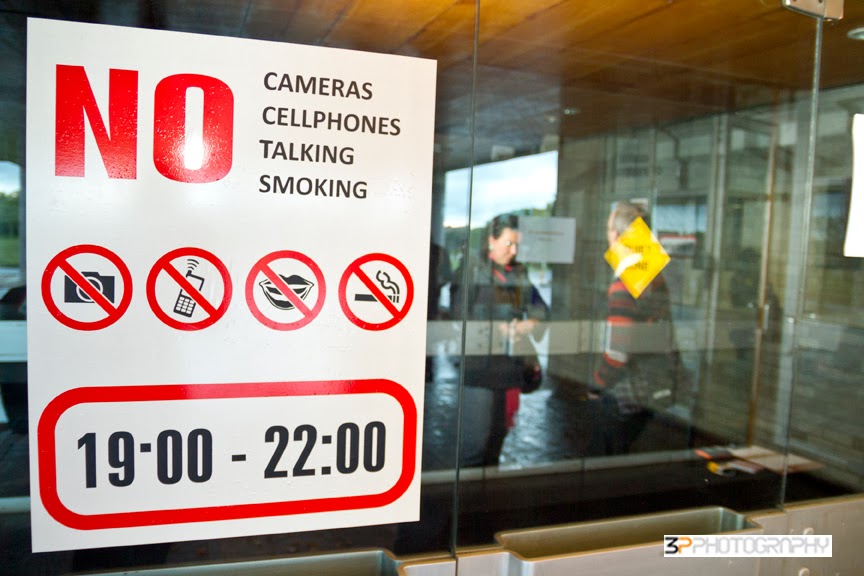 |
| Canon EOS 7D, Sigma 18-50mm at 18mm. ISO 200. f/2.8 @ 1/20th. Fill flash, bounced at 1/2th power. |
 |
| Registeration consists of fingerprinting, legal documentation and identification documents. Canon EOS 7D, Sigma 18-50mm at 31mm. ISO 200. f/2.8@1/20th. Fill flash. |
 |
| Canon EOS 7D, Sigma 18-50mm at 18mm. ISO 200. f/2.8@1/20th. Fill flash. |
So how does one even attempt to try and capture some of this in the images that will be used as documents of evidence for the exhibition? How does one record these elements when photographing/recording/capturing the event/experience? This is the conceptual concern and has little to do with the technical aspect. Yet.
The short answer is: with difficulty. via explores and disrupts the superficially tight definition of a non place by means of an organised walkabout where participants are invited to consider their own perceptions and ingrained social codes that evolve within these spaces. The experience was strictly controlled (by hired security guards) who managed queues, ordered and organised people into groups and escorted them to the various sections at specific times and intervals. Carefully placed interventions (the equivalent of 'artworks' I suppose, though they don't pretend to be) are blended into existing signage and indicators, or 'modes of management and organisation'. So it is tour-like but with an ominous and constant presence of authority and surveylance and control.
 |
| Canon EOS 7D, Sigma 18-50mm at 40mm. ISO 1600. f/2.8@1/8th. |
 |
| Canon EOS 7D, Sigma 18-50mm at 23mm. ISO 800. f/2.8@1/30th. Fill flash at 1/8th power. |
 |
| Canon EOS 7D, Sigma 18-50mm at 18mm. ISO 400. f/2.8@1/6th. Fill flash at 1/8th power. |
 |
| Canon EOS 7D, Sigma 18-50mm at 23mm. ISO 800. f/3.5 @ 1/30th. Fill flash at 1/16th power. |
 |
| Canon EOS 7D, Sigma 18-50mm at 24mm. ISO 800. f/2.8 @ 1/30th. Fill flash at 1/16th power. |
 | |
| Canon EOS 7D, Sigma 18-50mm at 23mm. ISO 400. f/3.5 @ 1/45th. Fill flash, bounced at 1/16th power. |
 |
| Canon EOS 7D, Sigma 18-50mm at 18mm. ISO 200. f/2.8 @ 1/8th. Fill flash, bounced at 1/8th power. |
 |
| Canon EOS 7D, Sigma 18-50mm at 35mm. ISO 400. f/3.5 @ 1/90th. Fill flash, bounced at 1/4th power. |
 |
| Canon EOS 7D, Sigma 18-50mm at 26mm. ISO 200. f/2.8 @ 30sec. Bounced flash, handheld with 2x firings at 1/2 power. |
Back to the photographing.... So couple the conceptual problem as outlined above with the very real limitations of space (or non space :) ), this time in a photographic sense and then add ... yep, you guessed it, bad light (again photographically speaking) and there is thus presented a very real challenge. What a pleasure!
 |
| Canon EOS 7D, Sigma 18-50mm at 21mm. ISO 800. f/2.8 @ 1/30th. Fill flash at 1/4 power. |
 |
| Photographic stitch using PS of three images. Canon EOS 7D, Sigma 18-50mm at 32mm. ISO 400. f/8 @ 30sec. Light painted with hand held torch |
Subscribe to:
Posts (Atom)